what the lovebirds (2020) gets right about the challenges of long-term relationships
This post is the second in a four-part series, reflecting on different ways that love is portrayed on screen. Check out the whole series.
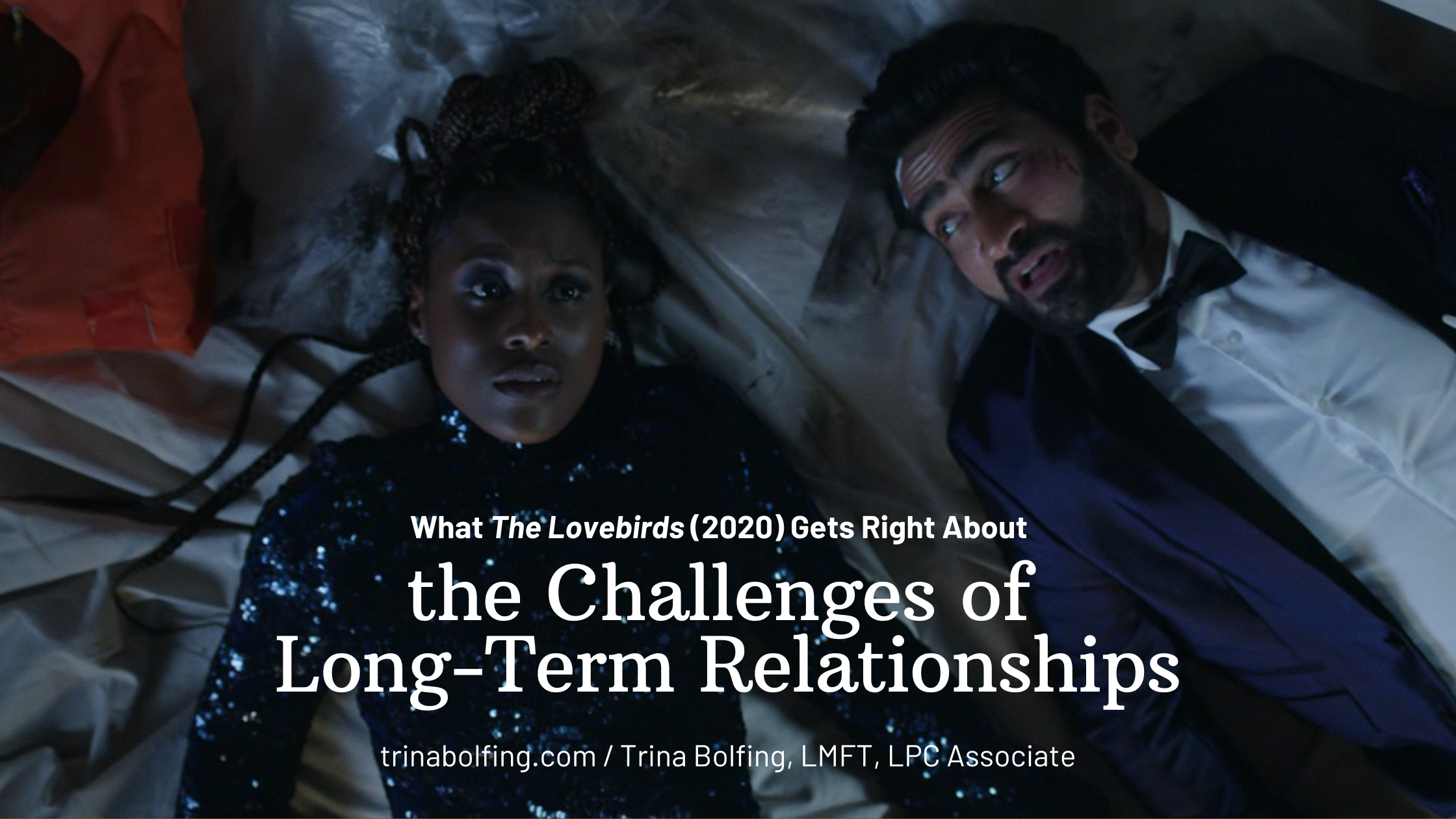
Today’s post is the second in my four-week series through the whole month of February, all about love. Last week in my post about Hunt For the Wilderpeople, I talked about being worthy of love in a film about chosen family. Today’s post will take us into Valentine’s Day with one of my favorite romcoms, The Lovebirds, directed by Michael Showalter. I’m pretty particular with this genre because there are so many movies that follow the traditional story arc a little too closely and contribute to our cultural obsession with happily-ever-after.
The Lovebirds is cut from a different cloth, however. It’s the story of Leilani and Jibran, and their whole meet-cute falling-in-love story is covered in a flash, over within the first few minutes of the film. Then we’re dumped into the room with this same couple, mid-fight, who has now been together four years. At nine minutes and 14 seconds into the movie, they’ve broken up.
Still steadfastly a romcom, the story also suddenly becomes a mystery and a thriller when the pair are implicated in a brutal murder, which they witnessed mere moments after their breakup. Rather than going their separate ways for the evening, like a normal breakup, they’re stuck with each other, avoiding repeated calls from the police and trying to find the person responsible for the killing.
early love versus long-term love
From there Leilani and Jibran find themselves in increasingly dangerous situations, all of which challenge them to confront their relationship issues. An interesting thing happens when you break up with someone and you still have to hang out with them. Suddenly you have no reason to keep your mouth shut about all of the things in your relationship that weren’t working because who cares if you offend your former partner. There are no stakes. When there are no stakes keeping you in line, a lot of shit gets worked out.
This film fits into the love theme this month because it asks us to ponder what it takes to stay together for the long haul. And it shows us normal challenges in long-term relationships don’t mean the relationship is doomed, it means you’re human and in relationship.
As a couples therapist, I love love. Of course I do. But early days love isn’t nearly as interesting to me as the commitment to love that comes later, like that between the couples who end up in my office working through challenges in long-term relationships. And like that between Jibran and Leilani. (So I guess spoiler alert, they get back together. But you already knew that because it’s a romcom, and a very good one at that.)
why bickering isn’t the real problem
All you bickering couples out there, you’ll find your on-screen soulmates in these two. They argue about pretty much everything. Even their flirtations lean sweetly antagonistic. In the montage of date scenes when they first meet, Leilani gives Jibran shit when he asks for her phone number (“Ooh…I’m not giving you my phone number”) and when she does, he says “You’ve made a huge mistake.” When they’re back together at the end of the movie and are contestants on the show The Amazing Race (which is in and of itself a callback to an earlier argument), the voiceover shares that “Jibran and Leilani lost valuable time after a heated argument about the metric system.”
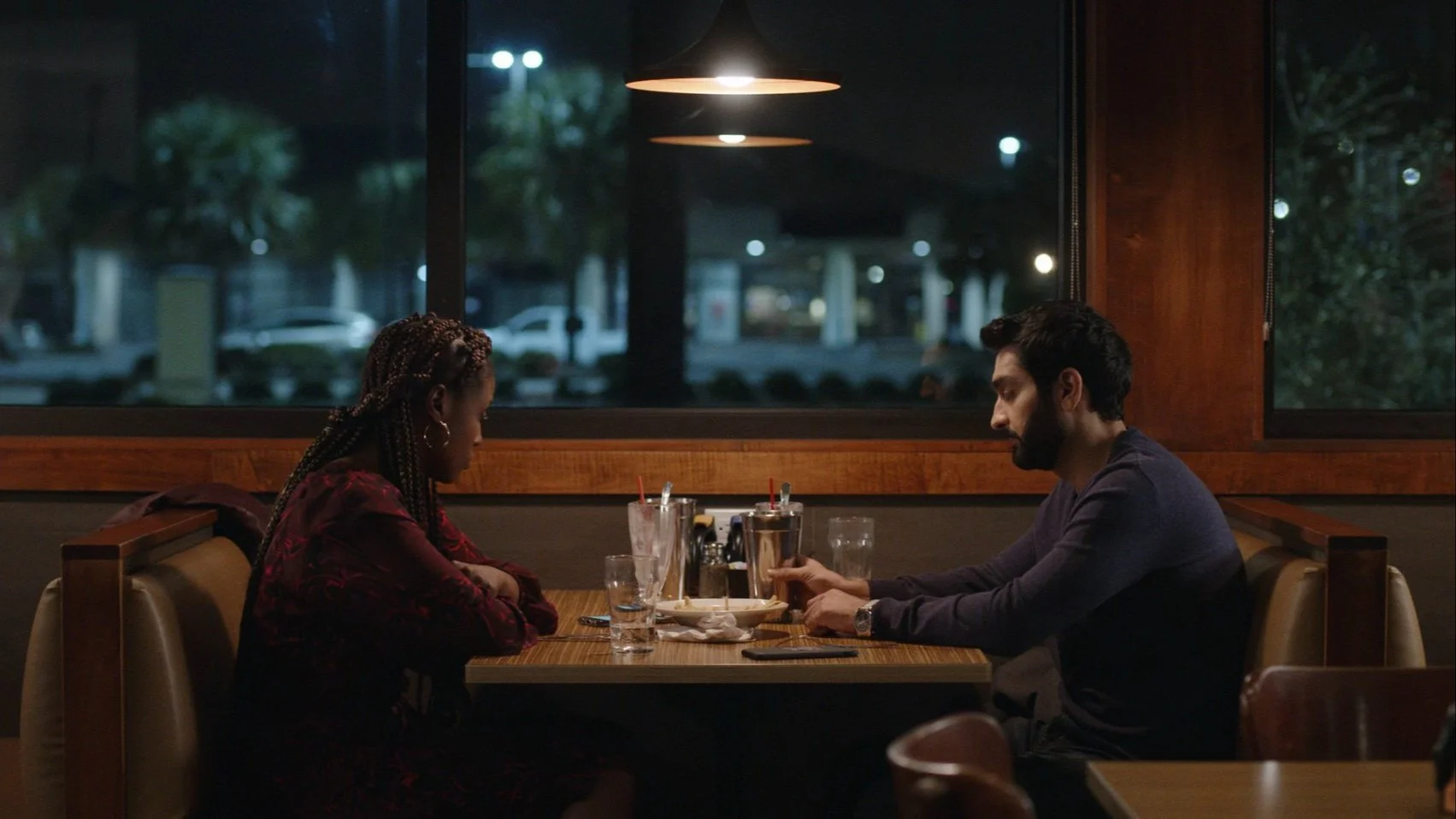
Leilani & Jibran are plagued by disconnection as they attempt to work together to investigate a murder.
Many of us are sitting on a handful of relationship fears, the ones where we tell ourselves, “I don’t ever want to be in a relationship where that happens.” Bickering is certainly one of those fears I hear people talk about. They see their parents do it, they see their friends do it, so they know they don’t want it. It’s one fear among many that stops some people from being truly open to a long-term relationship, even if it’s something they want deeply. (Quick pause: just making sure you caught the part where I said “even though it’s something they want.” If what’s stopping you from being in a long-term relationship is that you don’t want one, that’s totally ok!)
There are lots of other classic fears and horror stories about long-term relationships – the kinds of relationship problems I’m sure you’ve heard about: you stop having sex, you grow apart. You give up your own dreams, you run out of things to talk about. And you bicker nonstop.
how relationships change over time
I’m reminded of one scene wherein Leilani reflects on a memory from their first date. They were sitting next to a couple who didn’t talk to each other the entire time she and Jibran sat next to them. “You know I think about them all the time,” she says. “‘Cause I was looking at them like I never wanna be that couple, you know, that runs out of stuff to talk about. But the more I think about them, the more I’m like maybe they weren’t miserable. Maybe they were just comfortable with each other.”
It’s such an honest moment. Such a lovely reframe on our worst fears. I’m not sure about you, but for me personally, I feel like I’ve received a lot of messaging that when you say you want or need something, that’s it. You’ve committed. If you change your mind later, you’re a wishy-washy person who sends mixed signals to the people you date.
But what we want and need when we’re at the beginning of a relationship is not the same as what we need when we’re years in. We sometimes forget to carry that understanding of change over time, which is how we end up with people newly in love and people oldly (that’s a word, right?) in love – or out of it – judging each other.
In one scene, Jibran calls them a Lyft, but accidentally ordered a Lyft share (“I just have it set on that option by default!”) despite them being on the run from the police. A young couple climbs into the backseat and begins drunkenly lavishing each other with compliments and affection (“You’re amazing!” “But you’re like, amazing amazing.” “No, you are!”) Finally, Leilani has had enough and turns around to scream at them: “Shut the fuck up! Ok! It’s all kissy and huggy now, but it all comes crashing down,” which obviously silences them.
Leilani’s having a rough night by anyone’s standards, so I think we can all forgive her the outburst. But the sentiment is relatable to a lot of people. Years in, publicly engaging in drunken pillow-talk is not the norm for a lot of couples, so watching it unfold can feel strange or even annoying.
There’s an argument to be made for spending an evening here and there acting like drunk 20 year-olds in love. But an acknowledgement that needs and wants change over time is also warranted. And in a relationship where there’s more than one person whose wants and needs are changing over time, it stands to reason the relationship will need to adapt and be something different.
the conflicts that never fully go away
I think there’s another fear to be named here: the fear that we won’t know how to resolve problems in our relationships when they arise. That all is lost if we suddenly realize we’re having a dry spell or have been arguing more than normal. One thing I tell my couples clients is that every couple – seriously, I really do believe every couple – has a handful of conflicts or disagreements that never get resolved. Never. When things are good, those issues don’t feel like a problem. But when things are tough, this unresolved conflict feels enormous.
Those issues are often with you from day one. One person is a planner (Jibran), one’s spontaneous (Leilani). One tends to focus on heavier concerns (Jibran), one tends to sit in lightness with greater ease (Leilani). Years or decades in, what does it take to remind yourselves that you’ve managed to survive these differences in the past? And how do you do it now?
Sometimes you need help (ahem: couples therapy), especially when the same conflict keeps recurring. Sometimes someone needs to be brave enough to name what’s bothering them so that the rough patch doesn’t threaten to loom forever and you can go back to being unbothered by these pervasive issues.
saying the hard thing & being seen
For example, in The Lovebirds, when Jibran finally cops to his reasons for his years-long dislike of Leilani’s co-worker, Keith the IT guy, Leilani finally reaches a felt sense of understanding of a long-unspoken sense of insecurity plaguing the couple around this topic.
Leilani suggests they need Keith’s help to break into the phone stolen off the man they saw murdered. When Jibran responds with incredulity: “Keith? Fucking Keith?!” Leilani finally asks “What is your deal with him?” Jibran says, “I don’t like the way he looks at you,” to which Leilani responds, “He doesn’t look at me like anything.” Then Jibran finally shares “I don’t like the way you look at him.”
One approach I use as a relationship therapist is paying close attention to communication in relationships, especially what’s going unsaid. Is there an unspoken rule? Is there a topic that’s being avoided? Is there a “We don’t talk about Bruno” situation playing out? We have an almost magical belief that if we look at what we fear in our relationship, it will come to pass merely because we named it.
Jibran’s admission is so brave because, honestly, it doesn’t make him look that great, so I can see why he kept it to himself for so long. But it needed to be said. Sometimes we need to be open to saying – and hearing – things that don’t make us look great. Then sit in the vulnerability of hoping against hope that we’re understood and seen. In relationships where both people are working to see the best in each other and work through what’s troubling them, these moments are incredibly freeing.
what it means to keep choosing each other

Reconnection can be work - but totally doable.
Because of the film’s genre and tone, there’s really no question of whether they’ll get back together. But if there were a question, this scene about Keith is one of a handful where I had the feeling “They’ve got this. They’re going to get through this together.” Leilani took in what Jibran said and let the discomfort be there. Bickering has its place, but this moment wasn’t one of them, which speaks to a true depth of connection between them. In the course of their traumatic evening, they were willing to allow moments of authenticity to change their connection with each other, which ultimately saved them. (Well, it saved their relationship. Their lives were saved for different reasons, and there’s no need for spoilers for that part of the plot.)
Leilani and Jibran’s relationship is one I hold up as both believable and inspiring. Two people, sticking with each other and doing the best they can to imperfectly see the best in each other. Not bad for a romcom. If any of Leilani and Jibran’s struggles feel familiar to your own long-term relationship problems, and you’re wondering if couples therapy might help – this post discusses some really common themes that come up with the couples I work with in my therapy practice.
I hope you’ll come back next week for part three in my four-part series about love. Next week I’ll be talking about the film Someone Great. Take care.
Thank you for reading! I’m Trina, and I’m a therapist in Texas. I wrote this post myself using my own words and ideas. I used AI to help me optimize titles, headings, keywords, and meta descriptions for SEO purposes. AI also gave me some tips on how to share this post on social media. I will always let you know if/when/how I use AI in my blog posts.
If you’re in Texas and looking for a therapist, give me a shout. I’d love to learn more about you and your story.